AI UX Paradigms


How does interaction change when a language model becomes part of a larger process? From individual prompts through dialogue and modular workflows to delegated execution, each step changes what people need to specify, what they can delegate, and where they can intervene.
In August 2023, I explored this question at the ENHANCE Summer School at Chalmers. The talk, The Evolution of Interaction Paradigms for Large Language Models, followed a trajectory from command-based interactions through dialogue and modular workflows toward supervised and autonomous operation.
The progression changes the unit of interaction. A prompt asks for an answer. A conversation develops a task across several exchanges. A workflow makes its steps and dependencies explicit. Delegated systems take responsibility for choosing and carrying out more of those steps themselves. The design problem increasingly concerns how to direct, inspect, and revise an unfolding process.
Context shapes the response
Context shapes the response
Before comparing interfaces, it helps to distinguish what a model has learned during training from the information supplied for a particular interaction. Training changes the model’s parameters. A prompt and its accompanying context condition what it generates during use. Continuing a conversation does not, by itself, mean that the model is being retrained on that conversation.
The talk introduced embeddings as numerical representations through which a model can encode relationships in language. In the transformer architecture, attention provides a way to combine information from different positions in a sequence. An autoregressive language model uses the preceding tokens to produce a distribution over possible next tokens, then continues generating from that evolving sequence.
This makes context an interface concern. The same incomplete sentence can lead to different continuations depending on what surrounds it. One demonstration began with “Gothenburg is the … of Sweden.” Adding material about parks and sustainability steered the completion differently from material about music and festivals. These were demonstrations of contextual steering, not evidence that a generated description was factually justified.
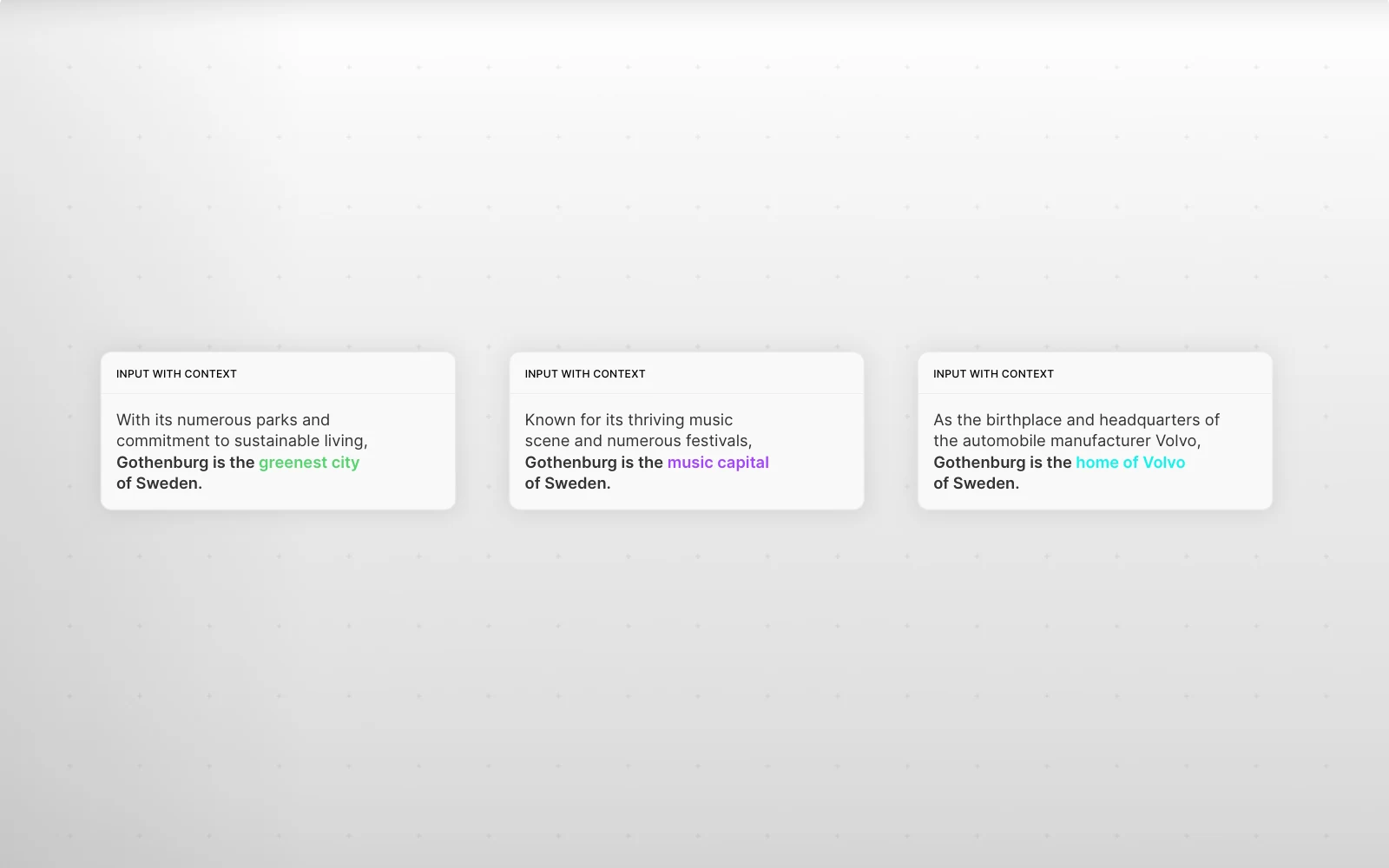
A useful interface therefore needs to expose what information is being supplied, where it came from, and which part of the task it is meant to inform. The text entered most recently is only one part of that context.
Five interaction paradigms
Five interaction paradigms
I arranged the interaction paradigms along an axis of increasing autonomy. The first three provided the concrete examples in the talk. The final two extended the same questions into delegated execution: what happens when the system begins choosing and carrying out the next steps?
| Paradigm | How the interaction is organized |
|---|---|
| Command-based interactions | A person supplies a task and the model returns a result. |
| User-driven interactive dialogues | A person develops the task through successive exchanges. |
| Modular interactive workflows | Context, operations, and outputs become separate, connected units. |
| Supervised semi-autonomous operations | A system carries out sequences of work with human oversight and intervention. |
| Fully autonomous operations | A system carries out the work with little ongoing human intervention. |
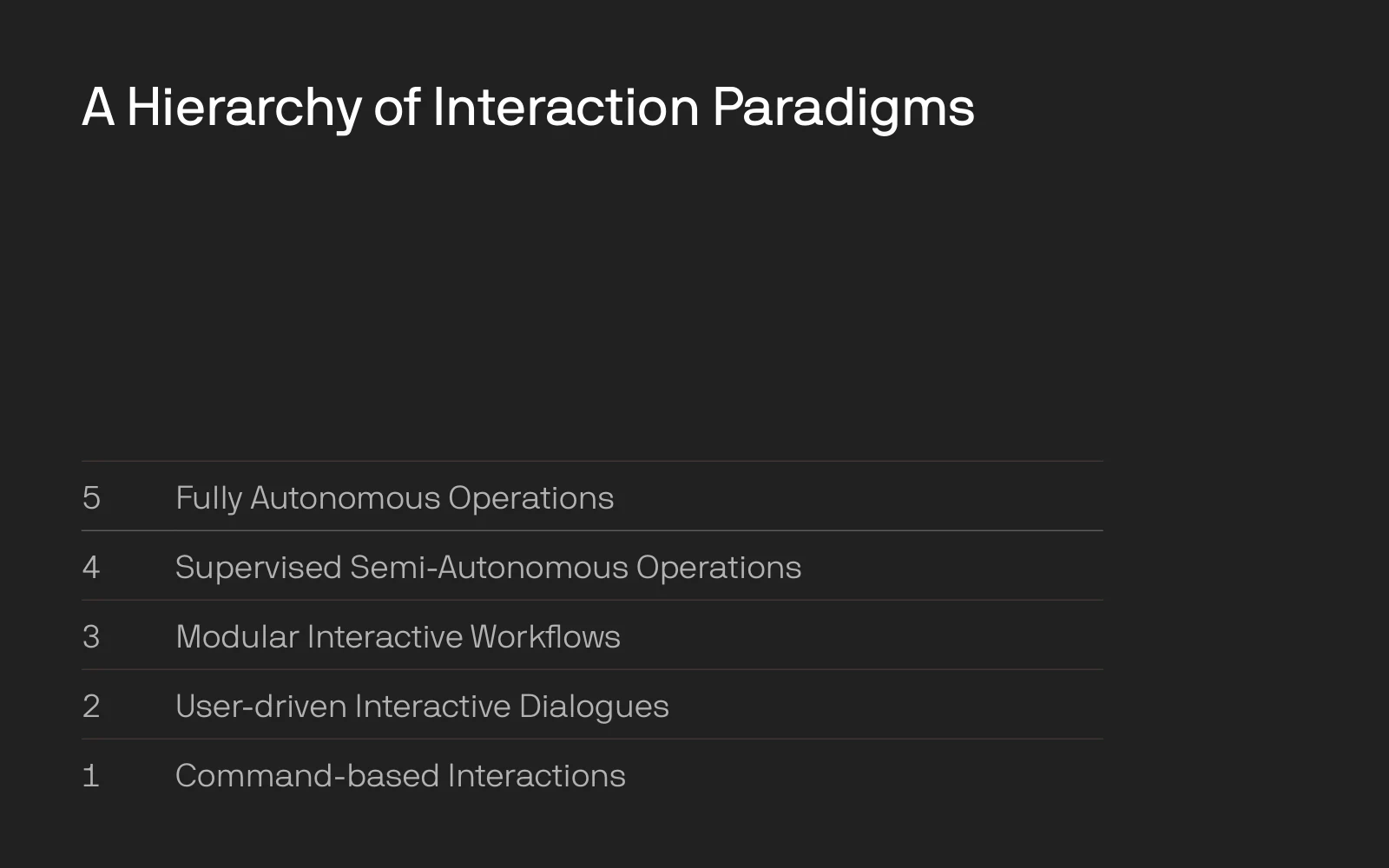
The distinction concerns how work is organized and who directs it. Greater autonomy changes the decisions an interface needs to expose; it does not remove the need to understand context or assess the result. The same questions about context, feedback, and control carry through the sequence, but they arise at a different scale as more work is delegated.
What a conversation leaves implicit
What a conversation leaves implicit
A command-based interaction has a simple structure: supply a request, receive an output. Translation is an obvious example. The difficulty begins when a task needs refinement. If each request is independent, the person has to reconstruct the relevant context for every attempt.
Dialogue reduces that repetition. In the talk’s example, a discussion of seaweed-based packaging continued through questions about business challenges and further advice. Earlier exchanges supplied context for later ones. A follow-up could refer to the idea without restating it in full.
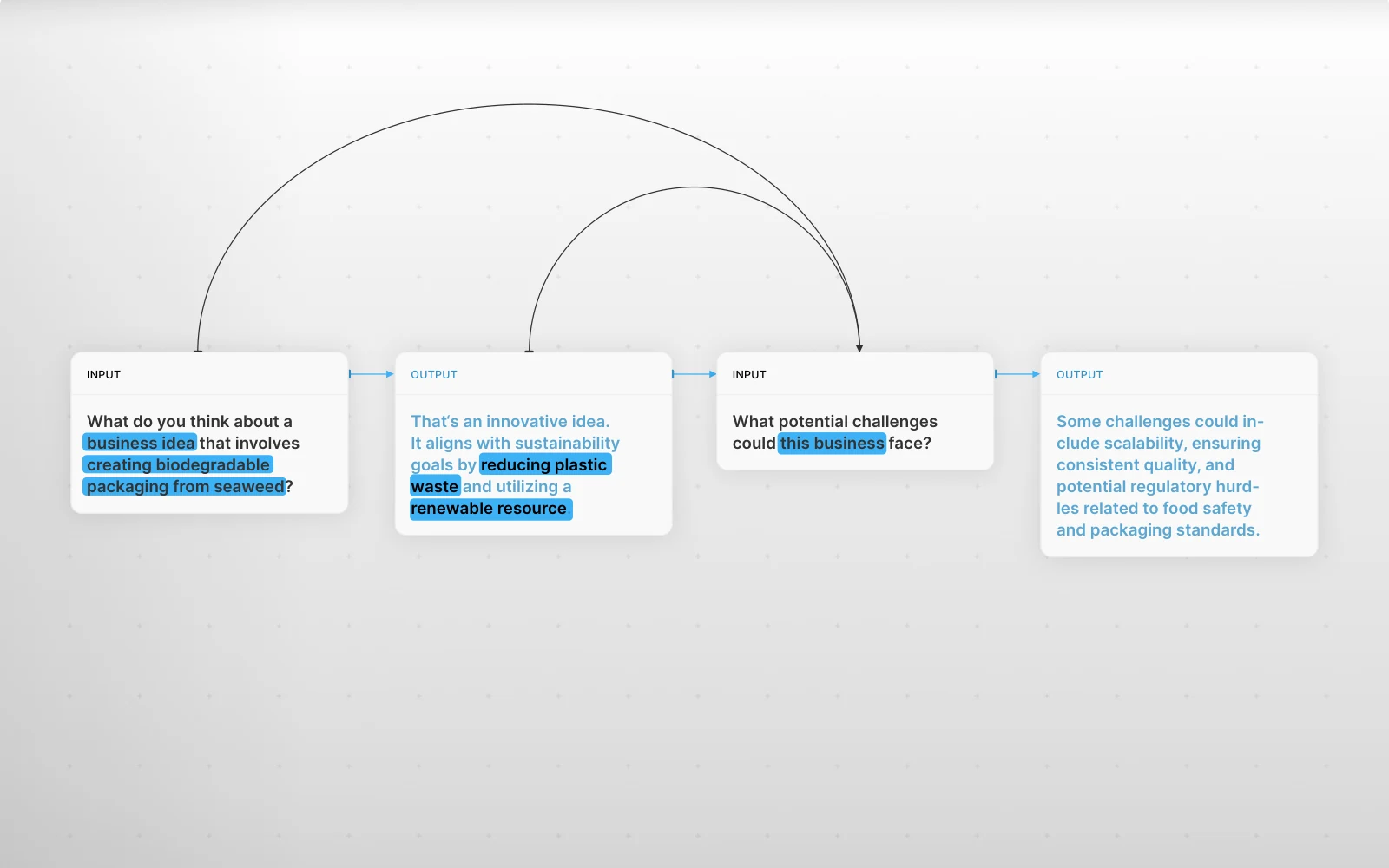
But the thread also becomes a record that both the person and the software have to manage. Background information, provisional ideas, instructions, and decisions accumulate in the same sequence. The distinction between something considered and something accepted can become difficult to reconstruct.
Revision exposes this problem. Changing an early assumption raises questions about later work: which responses depended on it, which remain useful, and which should be regenerated? Editing or branching a message can provide another route through a conversation, but the dependencies between its outputs still need to be understood.
The model has a bounded context window, and the person has limited attention. A longer thread puts pressure on both. The design question becomes how to make relevant context available without requiring the entire history to be reread and restated at every step.
Make dependencies explicit
Make dependencies explicit
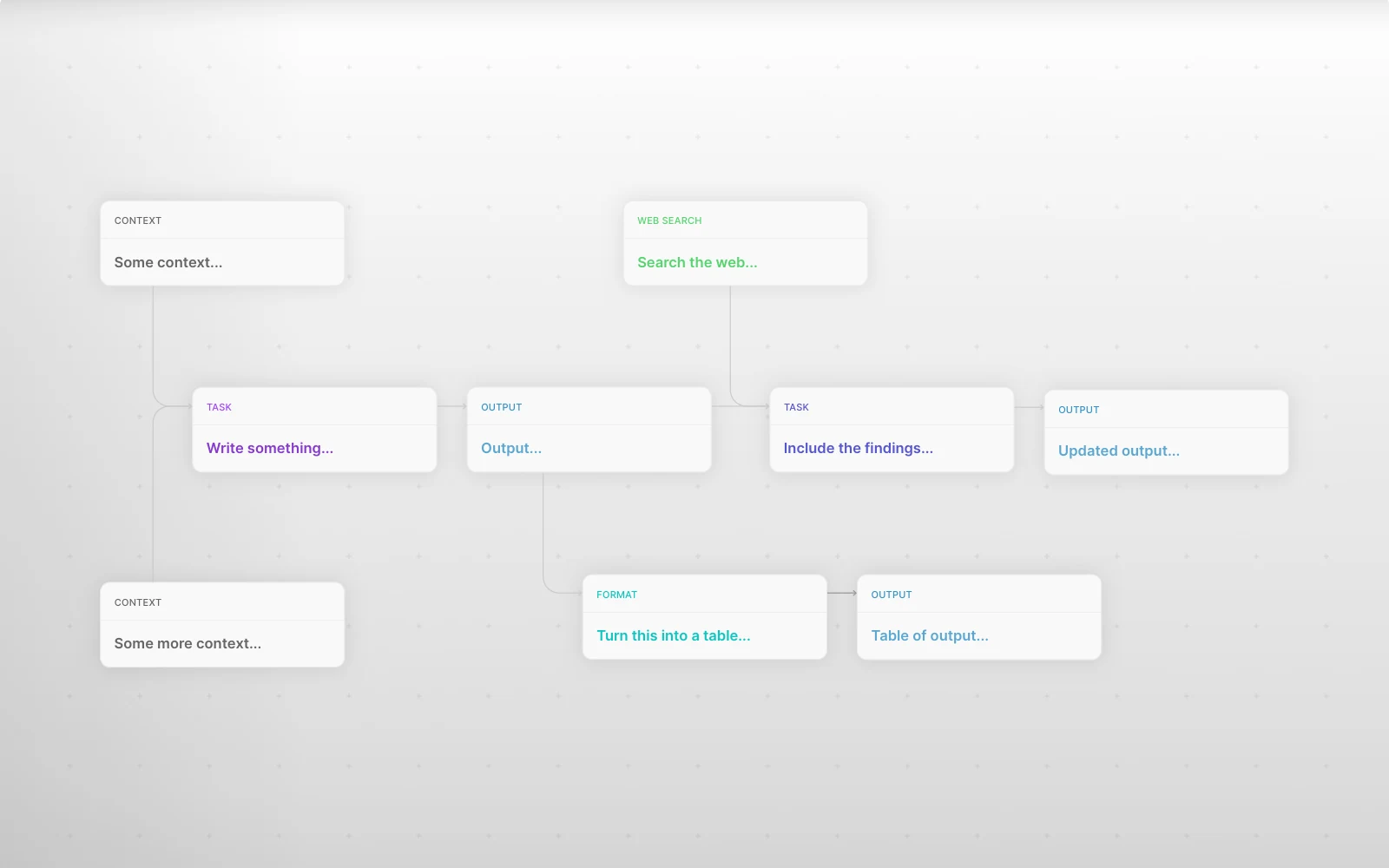
A modular workflow separates kinds of work that a conversation combines. Source material can be represented independently of an instruction. An operation can refer to several inputs. Its output can be inspected, selected, revised, or used by another operation.
Consider the request to write a research paper on sustainability. It leaves the research question, evidence, argument, and evaluation criteria unspecified. Producing a long answer does not settle those decisions.
The workflow in the talk began with a research focus and preliminary findings. These informed a topic-generation step. Several candidate topics remained visible, and a person selected one before moving to a thesis statement and outline. Changing the research focus could produce another set of candidates while retaining the same overall structure.
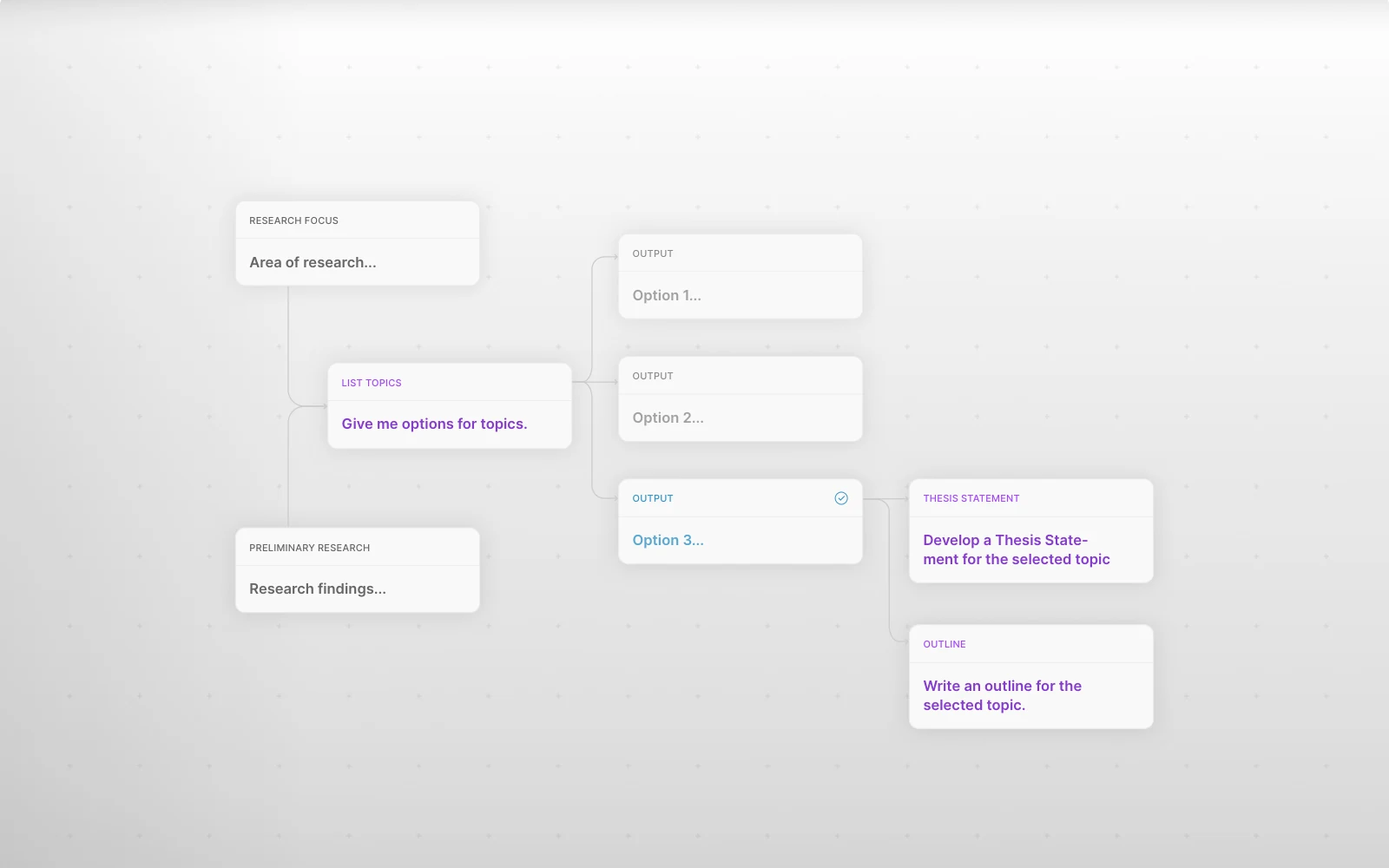
This decomposition gives revision a place to happen. A weak topic can be rejected before an outline is developed around it. A change in the evidence can be traced to the steps that use it. The same workflow can also be reused with different material, provided its assumptions still fit the new task.
Decomposition introduces its own decisions. Someone has to choose the boundaries between operations, specify what crosses them, and decide how the pieces will be evaluated together. A workflow can make these choices visible, but its structure can also carry a mistaken assumption from one step into every subsequent result.
Decomposition and supervision
Decomposition and supervision
The talk drew on Paul Christiano, Buck Shlegeris, and Dario Amodei’s Supervising strong learners by amplifying weak experts. Their proposal, Iterated Amplification, develops training signals for difficult tasks by combining solutions to easier subproblems. It addresses the difficulty of supervising work that a human cannot directly evaluate in full.
I used that work to motivate a question for interface design: can smaller units of work make human supervision more tractable? The modular workflows shown here concern the organization of model use; they do not implement the paper’s training procedure.
Intermediate outputs offer concrete things to examine. We can check whether a source is relevant, whether a proposed topic fits the research question, or whether an outline reflects the selected argument. That is useful visibility into the workflow. It does not reveal all of the model’s internal computation, and a generated explanation is not a complete account of how an answer was produced.
A spatial canvas for AI work
A spatial canvas for AI work
Hunch provided the practical examples. Its canvas made inputs, prompts, and outputs available as connected blocks. A person could inspect a local operation while retaining a view of the larger arrangement.
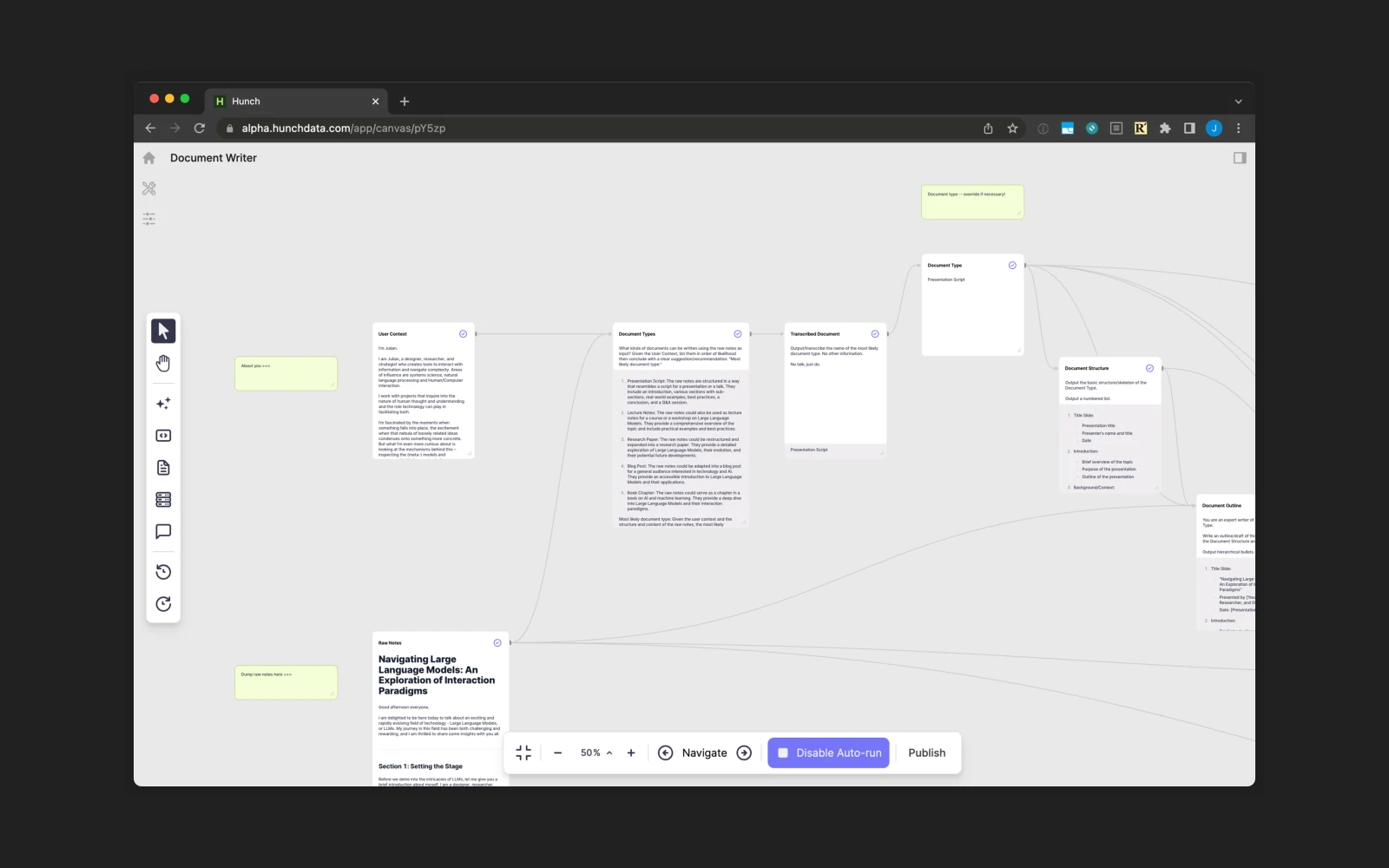
The document-writing example used notes and context to develop a document structure and draft. A product-idea workflow separated a brief, personas, value propositions, and other outputs. Another example explored questions about the automation of work. These demonstrated ways to organize generated material; a connected canvas did not establish the reliability of the resulting assessment.
The important interaction was the ability to select what continued through the workflow. In the research example, several candidate topics could be generated together, while only a chosen topic informed the next operation. Generation and selection remained distinct actions.
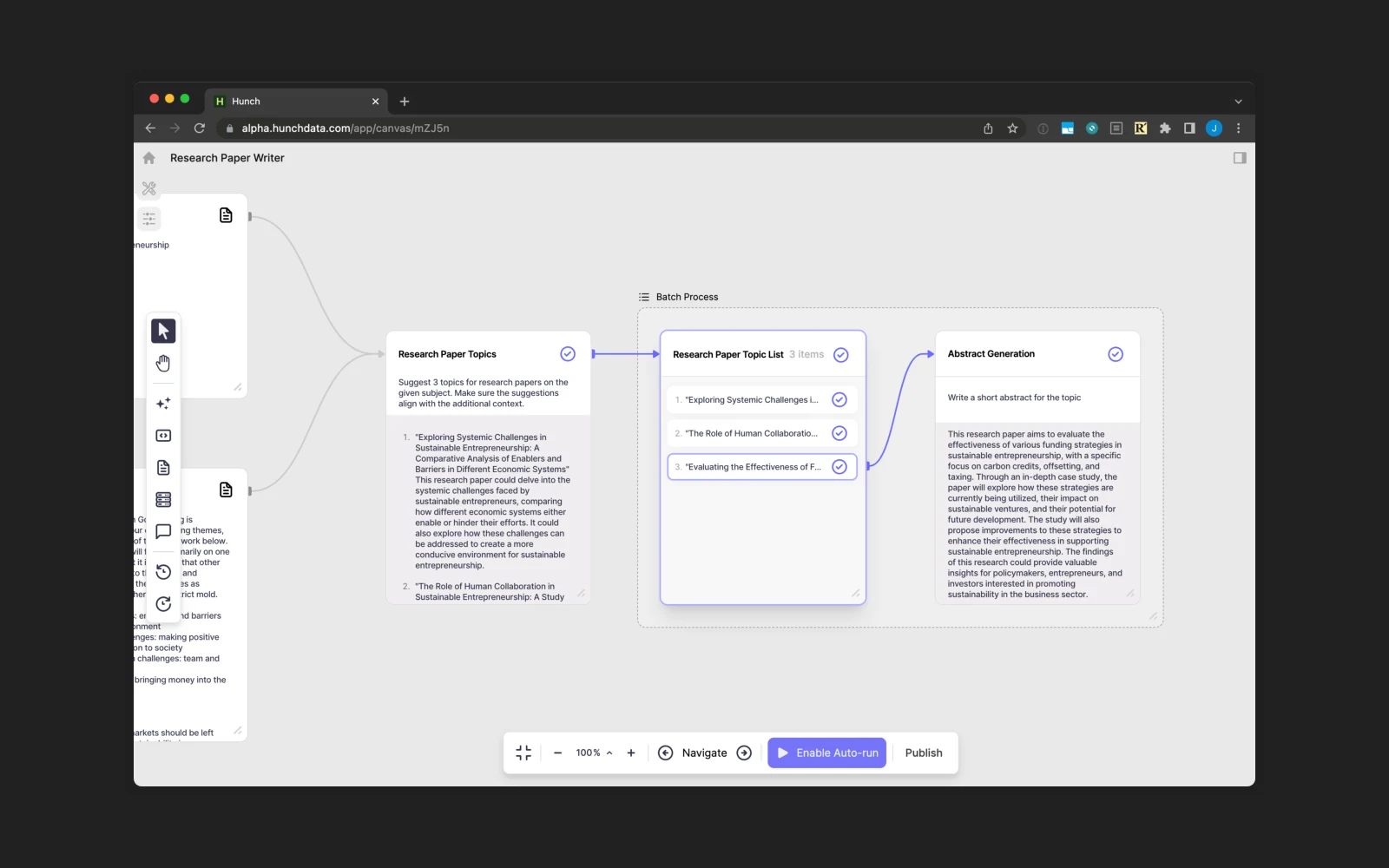
Spatial organization also has a cost. A large canvas can become another difficult information environment. Making every block visible is useful only if people can distinguish its role, follow its connections, and understand its current state. The aim is to make the structure of the work legible enough to intervene in it.
From workflows to delegated execution
From workflows to delegated execution
In a modular workflow, a person or developer largely specifies the structure in advance. An operation runs, passes material to another operation, and waits for the next condition to be met. A model can generate the contents of a step without choosing the overall route through the task.
Delegated execution changes that division of work. A system may decide which tool to use, whether a result requires another search, or how to divide a broad objective into smaller tasks.
This is the transition behind the talk’s fourth category, supervised semi-autonomous operation. The person specifies an objective and constraints, while the system carries out a sequence of actions. Supervision has to encompass the plan, intermediate findings, and decisions to continue or stop. Reviewing only a final answer leaves much of that activity outside the interaction.
The fifth category extends delegation further. It raises questions about what the system may do without another instruction, which conditions should interrupt execution, and what remains available for inspection afterwards. Greater autonomy requires a clearer account of the boundaries within which it operates.
Context, feedback, and granularity
Context, feedback, and granularity
The practical guidance in the talk followed from these examples. Give an operation the context it needs, and label the parts so their roles remain clear. A research question, a source passage, and an instruction to the model should be distinguishable even when all three eventually enter the same request.
Specifying a role can also help describe an operation’s purpose: critique this draft, propose alternatives, or check consistency. It still needs criteria and relevant material. A model assigned the role of a reviewer has not thereby acquired the evidence needed to review a particular claim.
Feedback belongs inside the workflow. Generate alternatives, inspect them, select a direction, and revise. The person directing the work often holds constraints that have not been written into the prompt. Giving them a decision point makes it possible to bring those constraints into the process.
Granularity should change with the inquiry. Exploring a research area may call for several candidate directions. Developing one of them calls for a narrower question and more detailed work. A fixed sequence that always compresses alternatives immediately can close off exploration too early.
The same applies to uncertainty. An operation should leave room to request missing information or return an unresolved question. Otherwise, the workflow may turn an unsupported assumption into apparently finished material simply because the next block expects an answer.
Design the points of intervention
Design the points of intervention
The workshop concluded with an assignment: sketch a modular AI workflow for a research project. Break the work into reusable units and apply at least three of the practices discussed in the talk.
A useful sketch identifies the material available at each step, the operation performed on it, and what has to be judged before continuing. It should also show where a person can select an alternative, supply missing context, or return to an earlier assumption.
For a single conversation, intervention may mean revising a prompt. For a workflow, it may mean changing an input and rerunning dependent operations. As more decisions are delegated, people need ways to inspect intermediate work, revise constraints, and interrupt execution.
Revisiting the talk in 2026
Revisiting the talk in 2026
Agents have become more capable since this talk. They can use tools, pursue longer tasks, and orchestrate work across many subagents. Systems such as Claude Research already divide investigations among agents with separate contexts and combine their findings. Yet explicit flows remain useful within these orchestration patterns: deciding when to branch, what to pass between operations, where to review a result, and when to stop.
The skill-sharing ecosystems developing around agents offer a way to accumulate and reuse this procedural knowledge. The Agent Skills format, for example, packages instructions, scripts, and reference material that agents can load for a particular task. I see these ecosystems as a step toward pattern libraries of flows: reusable ways to organize research, review, implementation, and other work. A skill can describe a procedure without fixing every step in code; its usefulness still depends on when it is selected and how it fits the surrounding process.
This makes harness design and routing decisions central to the interaction. The harness supplies the execution environment: tools, context management, permissions, and mechanisms for continuing or interrupting work. Routing determines which procedure or agent receives a task and what context goes with it. More powerful agents give us greater freedom to delegate these decisions, while the quality of the resulting work still depends on how we structure dependencies, feedback, and supervision.